


28.4K Summit 2017 by endovereric
first prev 1 next last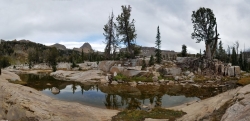
Alaska Basin
Driggs, Idaho
10.0 miles E of Driggs, IdahoThe Alaska Basin Trail is a stunning trail through the Jedediah Wilderness near Driggs, Idaho and goes East into Wyoming, just outside of Grand Teton National Park. The trail is wide and has easy terrain for the feet, but it is long, so it's best suited for intermediate to advanced hikers. There are spots on the trail where river crossing is necessary, so be prepared to rock hop, cross logs, or just get your feet wet.
Because the trail is in a wilderness area, rather than a National Park, no overnight camping permits are required; however, open fires are not allowed, so plan on bringing a camping stove. Carry bear spray and, if you are camping, plan on bear proofing your food and waste.
The trail features a variety of landscapes such as lush vegetation and wildflowers (peak season is July to August), rushing rivers and streams, the majestic Teton Mountain Range, and of course, the serene Alaska Basin. There is plenty of wildlife; black bears and moose both have been spotted on the trail. Enjoy their beauty, but please use precaution and respect their territory.
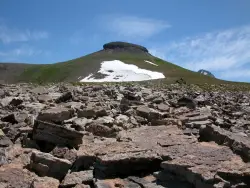
Table Rock / Table Mountain
Driggs, Idaho
10.0 miles E of Driggs, IdahoAt roughly 11,100 feet, the flat-topped summit of Table Mountain serves up what many consider the single finest view of the Grand Teton anywhere — and one of the great day hikes on the quiet, western (Idaho) side of the range. From the broad mesa top you stand just far enough back to take in all three Teton peaks at once, yet close enough to pick out the detail on the Grand's sheer east face across the deep gulf of the canyon. It's a jaw-dropping payoff, and a hard-earned one.
The mountain holds a remarkable place in history. In 1872, pioneering survey photographer William Henry Jackson hauled his heavy glass-plate camera gear by mule to the top of Table Mountain and made the first photographs ever taken of the Grand Teton — images that helped introduce the range to the wider world and build support for protecting it. Jackson chose this peak precisely because its gentle western slopes could be reached without technical climbing, and that's still what makes the summit attainable for strong day hikers today.
The trailhead sits at the end of Teton Canyon Road outside Driggs and Alta, and nearly the entire route lies within the Jedediah Smith Wilderness of the Caribou-Targhee National Forest. There are two main ways up, and both climb over 4,000 feet. The Face Trail is the steeper, shorter option (about 3.5 miles one way), skipping the switchbacks to head more or less straight up. The Huckleberry (North Fork) Trail is longer but far more gradual (about 6.5 miles one way), following and crossing the North Fork of Teton Creek — handy spots to filter water — through meadows and, in mid-to-late summer, ripe huckleberries for those who beat the crowds to the bushes. Many hikers link the two into a big loop of roughly 11–13 miles, and tough-but-knee-conscious hikers generally prefer to climb up the steep Face and come down the gentler Huckleberry, sparing their knees the pounding of a steep descent. The lower trail is a delight in its own right, tracing rushing Teton Creek past a string of waterfalls.
The wildflowers here are spectacular. As the snow recedes, Table Mountain's meadows erupt in color — sweeping displays of lupine, arrowleaf balsamroot, and Indian paintbrush, with columbine in the shadier pockets and delicate alpine blooms up high. In the Tetons the canyon meadows tend to peak from early-to-mid July, while the highest ground saves its show for late July into August; even when snow still blocks the upper trail, the lower meadows near the trailhead put on an easy, photogenic display. It's one of the finest wildflower hikes in the region.
This is high, exposed country, so plan accordingly. At over 11,000 feet the air is thin and the weather changes fast: afternoon thunderstorms build quickly over the peaks in summer, so start early and aim to be off the open summit by early afternoon. Table Mountain is enjoyed year-round — it's a popular snowshoe and backcountry-ski destination in the snowy months. If you're after dry summer hiking, though, know that you're likely to encounter snow on the upper mountain before mid-July: early-season snowfields often begin around 9,500 feet with larger patches up high, and the Huckleberry side can hold avalanche debris and downed trees until it melts out. It's frequently still passable with the right footwear — just come expecting it. Conditions are typically most reliably snow-free from about mid-July through September. It's also easy to lose the trail, especially on the descent, so pay attention to your route and carry a map or GPS. Keep an eye out for wildlife, too — moose are a common sight in the canyon, and the area is home to the occasional mountain lion.
Bring layers, sun protection, plenty of water (and a filter), and sturdy footwear for the long, steep grade. You can check current conditions on the webcams at tetoncam.com before you drive up. Backpackers sometimes camp in the meadows below the summit to catch the Grand at sunrise — an unforgettable sight — while following Leave No Trace and wilderness regulations. However you do it, Table Mountain earns its reputation: a leg-burning climb to a mesa in the sky, carpeted in wildflowers, with the Grand Teton filling the horizon just as it did for Jackson a century and a half ago.
Gannett Peak
Gannett Peak, Wyoming 82513, USA
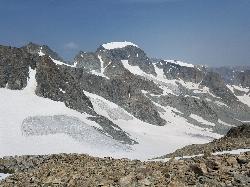
At 13,308 feet in elevation, Gannett Peak is considered to be one of the most difficult state highpoints, rivaled only by Alaska's Denali, Washington's Mount Rainier, and Montana's Granite Peak which have a range of difficulties based on weather and conditions of the climb.
July to August are considered to be the best times to go. If you try too early in the season, all the streams and lakes are still frozen over. If you go too late, then snow and bad weather is more common which makes more a much more strenuous hike. The downside to going in July and August is that the Wind Rivers are renowned for horrendous swarms of voracious mosquitoes. Many climbing parties prefer visiting during July when the Gooseneck Glacier bergschrund (and other crevasses) are not yet fully opened (if at all). Snowpack can actually make a summit attempt less strenuous than travelling on ice and/or rock for long distances.
There are three major trails to the top:
- Pole Creek Trail to Titcomb Basin
This is a 40 mile round trip with approximately 9050 feet cumulative elevation gain. This route has long been considered the main standard approach for Gannett Peak, although the Glacier Trail approach from the east has been gaining popularity during recent years. This western approach is a well-travelled route full of spectacular scenery and views. - Glacier Trail
This trail is a 50 mile round trip from the Dubois side and has a cumulative elevation gain of 10,750 feet. The biggest advantage to this route is it puts you at a higher camp for your summit day giving you a better chance of success and less strenuous terrain than the standard western approach. - Ink Wells Trail
The advantage of this route is that a large amount of distance and effort can be saved by the time the route intersects with the Glacier Trail. However, the disadvantage of this route is that access is both limited and expensive. This route crosses the Wind River Indian Reservation, which requires special permission, guidance, and transportation to travel through. Reservations are required in advance and sometimes difficult to achieve, and even if a reservation can be made, the cost can be substantial.
Teewinot Mountain
Jackson Hole, Wyoming
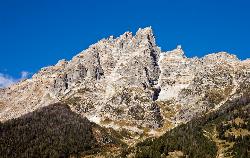
17.7 miles N of Jackson Hole, WyomingTeewinot Mountain is one of the great sights of Grand Teton National Park — a soaring 12,325-foot fin of rock that rises straight above Jenny Lake and dominates the view of the range from the valley floor. Its name comes from a Shoshone word meaning “many pinnacles,” and while it can look like a hiking peak from a distance, reaching its summit is a committing mountaineering objective, not a trail walk.
The standard line is the East Face, begun from the Lupine Meadows trailhead south of Jenny Lake. From there the route climbs relentlessly — roughly 4,000 feet of gain in under two miles — first up dozens of steep switchbacks, then through open, flower-filled meadows, and finally onto the face itself. High on the mountain, around 10,500 feet, you pass beneath two prominent rock spires known as the Idol and the Worshipper, a landmark that marks the way onto the upper face.
The climbing is rated roughly 4th class and is often done without a rope by experienced parties, but that grade undersells it: the Tetons are famously sandbagged, the route-finding is complex, exposure is serious, and much of the rock — especially up high — is loose. Snow lingers in the couloirs and the steep “Narrows” well into summer, where an ice axe (and the skill to use it) can be essential. Teewinot is widely considered the deadliest peak in the Tetons: the upper face funnels rockfall, and the crux for many parties is the descent — downclimbing the same steep, loose ground, where many falls and fatalities have occurred. A rope for rappels and downclimbing is wise.
This is a full, dawn-to-dusk day for fit, experienced mountaineers with solid scrambling skills, good judgment, and the gear to match — a helmet is a must for the rockfall, and many climbers hire a guide through the park's concessioners (such as Exum Mountain Guides or Jackson Hole Mountain Guides) for a first ascent. The usual season is mid-summer into early fall, once the snow has consolidated or melted out.
A park entrance fee applies, and this is grizzly country, so carry bear spray on the approach and store food properly. Start in the dark to be off the summit before afternoon thunderstorms build, know the descent as well as the ascent, and turn around if the rock, weather, or your party isn't solid. And if you're not equipped for serious alpine terrain, take heart: Teewinot is arguably even more beautiful from below — admire its pinnacles from the Jenny Lake shore, one of the finest mountain views in the country.


