


5 locations
Add Location
 Full Listing
Show more
Hot Springs, Swim
Added on 13 Feb 2022
 Full Listing
Show more
Hot Springs, Swim
Added on 13 Feb 2022
14.8-15.1 mi
 Full Listing
Show more
Hike, Hot Springs
Added on 13 Feb 2022
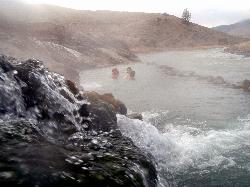
Mr. Bubbles Hot Spring
Old Faithful, Yellowstone National Park
24.0 miles SW of Old Faithful, Yellowstone National ParkMr. Bubbles is one of the very few places in Yellowstone National Park where you can legally and safely soak in naturally heated water — a rare treat in a park where hot springs are usually deadly rather than inviting. It sits deep in the Bechler region in Yellowstone's remote southwest corner, an area known as “Cascade Corner” and one of the park's best-kept secrets: far from the paved roads, boardwalks, tour buses, and gift shops, reached only by miles of backcountry trail.
The soak itself is a natural mixing pool. A hot spring wells up into the cold Ferris Fork of the Bechler River, and where the scalding spring water blends with the cold river it reaches a blissfully soakable temperature — while gas bubbling up from below gives the spot its playful name. That mixing is also the key to why soaking here is allowed: getting into Yellowstone's thermal features is strictly forbidden, but the Park Service permits soaking where hot water has already blended with a river or stream. Enjoy the warm water where it mixes, and stay well clear of the undiluted hot source.
You'll find it roughly halfway between the Bechler Ranger Station and Old Faithful along the Bechler River Trail. This is genuine backcountry — most visitors reach it on a multi-day backpacking trip, walking singletrack dirt trails past waterfalls and meadows and seeing wildlife well outside the safety of a car. Be bear-aware and give bears, moose, and bison plenty of space. To camp along the way you'll need a backcountry permit, reserved through the park's backcountry office.
The journey is a huge part of the reward. The Bechler is nicknamed Cascade Corner because it holds more waterfalls than anywhere else in Yellowstone — the trail near Mr. Bubbles strings together beauties like Colonnade, Iris, and Ouzel Falls, and nearby Union Falls is one of the park's most spectacular. For backpackers, a soak at Mr. Bubbles makes the perfect midpoint of a waterfall-studded wilderness traverse.
A few life-or-death cautions. Thermal water temperatures here change without warning and are not always safe — the National Park Service advises checking with a ranger station on current conditions before you plan a trip. And never hike through Yellowstone's thermal areas at night: even experienced hikers have broken through thin crust and been scalded to death in unexpected hot ground. Always review the park's swimming-and-soaking guidance for current closures, regulations, and conditions before you go.
Timing matters in the Bechler. It's the wettest corner of Yellowstone, with numerous river fords that run dangerously high during spring and early-summer snowmelt, so the backcountry here is generally best from late summer into early fall, once the water drops. Come prepared for remoteness, river crossings, mosquitoes, and sudden mountain weather — and you'll be rewarded with a genuinely wild Yellowstone soak that few visitors ever experience.
15.9-16.6 mi
 Full Listing
Show more
Backpack, Hike, Hot Springs, Swim
Added on 13 Feb 2022
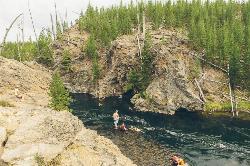
Union Falls & Ouzel Pool
Bechler Ranger Station, Yellowstone National Park
5.4 miles E of Bechler Ranger Station, Yellowstone National ParkUnion Falls is one of Yellowstone's hidden masterpieces — a wide, fan-shaped curtain of water around 250 feet tall, tucked deep in the park's remote Bechler region, the wild southwest corner known as Cascade Corner. Almost nobody driving the loop road ever lays eyes on it, and that's exactly the appeal: this one you earn on foot, well off the tourist track, and it rewards every mile.
The trek runs roughly 16 miles round trip, making it a big day hike or a wonderful overnight backpack. Most of the walking is gentle, threading through lodgepole forest and open meadows in classic Bechler fashion, with one memorable obstacle about a mile in: a ford of the Falls River. Early in the season that crossing runs swift and deep, but by mid-July it settles to a straightforward wade — bring shoes you can strap on and trekking poles for balance. Backcountry campsites a few miles in let you split the trip, soak in the scenery, and reach the falls fresh.
Then there's the bonus that makes this trip legendary: Ouzel Pool, also known as Scout Pool. A short side trip off the main trail — about a mile and a half each way — leads to a natural swimming hole fed by a warm spring, with a small waterfall pouring in over the lip. By late summer the water warms to something close to a tepid bath, a rare treat in the high country. The pool is roughly 20 feet across and seven feet deep, with a bedrock shelf for easy wading and a big rock that begs to be jumped from — cannonballs only, since it's too shallow to dive. Strong swimmers can paddle up under the falls and sit beneath the rush.
This is genuine Yellowstone backcountry, so come prepared and come respectful. It's grizzly country: carry bear spray, make noise, and store your food properly. The mosquitoes are serious in early summer, so pack repellent and a head net for June and early July. Overnight trips require a backcountry permit from the park, reservable in advance or at a ranger station, and there's no cell service back here — let someone know your route.
Timing makes or breaks this one. Mid-July through September is the sweet spot, when the Falls River ford is friendly, the bugs ease off, and the swimming is at its best. Earlier than that and high water can turn the crossing dangerous; later and the days get short for such a long round trip. Get an early start, pace yourself for the miles, and you'll come away with one of the most complete days Yellowstone has to offer — a thundering 250-foot waterfall and a warm, wild swimming hole, all in one walk. Few places reward the effort quite like this.
6.9 mi
 Full Listing
Show more
Backpack, Camp, Hike, Hot Springs
Added on 13 Feb 2022
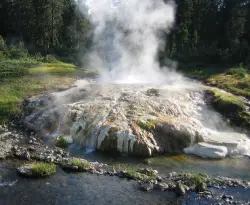
Heart Lake Trail
Grant Village, Yellowstone National Park
5.7 miles S of Grant Village, Yellowstone National ParkThe trail is very clear and leads to a moderate eight mile hike to Heart Lake. This hike has many possibilities. Day hikers need to push their time to make sure they are on the trail early to allow enough time to enjoy the lake, and then get back on the trail before dark. Backpackers can hike into a campsite near the lake and/or you can hike to and around the lake and camp out for a couple of days. Many hikers have said that if you plan to spend more than a couple of days that hiking to the summit of Mount Sheridan is a must, which may add an extra day to your trip.
The trail leads you to great thermal features and is very scenic. You will see deep blue pools, fumaroles, steam vents and Rustic Geyser. Remember to use caution and respect when around these fragile features, especially since the ground can be very unstable.
The fishing from the drainage of Heart Lake is remarkable. This is one of the reasons why this location is popular. If you catch a native fish to the park, you can catch and release it. If it is nonnative, there is no limit to how many fish you can catch. Native fish include the cutthroat trout, mountain whitefish and Arctic grayling. Nonnative fish include: brown trout, brook trout, rainbow and lake trout. Fisherman are asked to only fish with single, pointed, barbless hook and lead-free artificial lures. All watercraft needs to have a permit purchased from the park service.
Due to bear activity, the trail is closed from April 1 to June 30 each year. You should carry bear spray and make noise as you hike to keep wildlife away.
Boiling River
North Entrance, Yellowstone National Park
0.5 miles S of North Entrance, Yellowstone National ParkThe Boiling River is created where a large hot spring enters the Gardner River, allowing the hot and cool waters to mix into a temperature comfortable enough to bathe in. The natural hot tub makes a great place to stop and relax while soaking in the warm water and soaking up the natural beauty of Yellowstone.
WARNING: After about half a mile into your hike to The Boiling River, the trail circles a seductive looking stream coming from an outcropping on the riverbank. The clear water may look appealing, but DO NOT dip your toes in yet. You can get immediate and severe burns by entering the runoff channel directly. It simmers at extreme temperatures between 113 to 140 degrees! Instead, follow the trail to the end where the stream pours into the significantly colder waters of the Gardner River, where will you be safe enough to enjoy a nice swim.
Check https://www.nps.gov/yell/planyourvisit/swimming-soaking.htm for closures, regulations, and conditions.
Firehole River
Madison, Yellowstone National Park
1.9 miles S of Madison, Yellowstone National ParkThe Firehole River starts south of Old Faithful, runs through the thermal areas northward to join the Gibbon and form the Madison River. The Firehole is world famous among anglers for its pristine beauty and healthy brown, brook, and rainbow trout.
Firehole River Canyon in Yellowstone N.P. is a great place to spend a few hours and get a respite from the desert sun. It includes rapids emptying into a deep pool as well as shallow sections outside the current. All should be careful to keep out of the main current.* The water is warm for this elevation because the river contains the runoff from many thermal features, including Old Faithful. Portable toilets are available (as of summer 2001). Camp at Madison campground near Madison Junction near the West Yellowstone entrance in order to be near the swimming. Courtesy of swimmingholes.org
The river is surrounded by geothermal features which empty water into it, which in turn affects the temperature of the water. Temperatures in the river have been measured as high as 86 °F and average 9 to 18 °F higher than areas upstream of geothermal influence. It is always good to discuss the water temperatures with a local park ranger to make sure temperatures are safe.
*WARNING: All should be careful to keep out of the main current - A GIRL DIED HERE IN 2003 JUMPING INTO THE CURRENT AND GETTING TRAPPED UNDER AN OVERHANGING ROCK - DON'T DO IT.) Courtesy of swimmingholes.org
Check https://www.nps.gov/yell/planyourvisit/swimming-soaking.htm for closures, regulations, and conditions.
×


