


28.4K Bucket List by endovereric
first prev 1 next last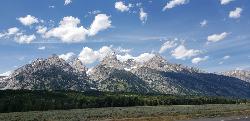
Grand Teton
Jackson Hole, Wyoming
17.6 miles N of Jackson Hole, WyomingAt 13,770 feet above sea level, the Grand Teton towers majestic over Southeastern Idaho and Western Wyoming, making it a life goal of many amateur climbers and outdoor enthusiasts.
The more popular routes all begin at the Lupine Meadows Trailhead and continue up through Garnet Canyon and The Meadows before splitting North. Most routes require rock climbing equipment and are only for skilled climbers. A guide is highly encouraged on any route. With 3k feet of exposure, falling from multiple segments of the trail would mean certain death.
Trailhead altitude: 6,732 ft
Summit altitude: 13,770 ft
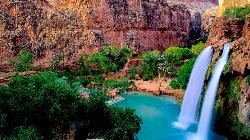
Havasu Falls Trail
Flagstaff, Arizona
89.4 miles NW of Flagstaff, ArizonaFew places in America inspire as much longing as Havasu Falls — the impossibly turquoise waterfall that has become a bucket-list icon of the Southwest. It lies deep in Havasu Canyon on the Havasupai Reservation, a side canyon of the Grand Canyon so remote it can be reached only on foot, by pack mule, or by helicopter. The Havasupai are the “people of the blue-green water,” and this is their homeland: a hidden desert oasis where waterfall after waterfall pours over red travertine cliffs into pools the color of the Caribbean.
That astonishing blue-green color is no trick of the light. Havasu Creek is spring-fed and saturated with calcium carbonate, which scatters sunlight into the vivid turquoise hue and, over time, deposits as travertine — building the smooth ledges, terraces, and natural dams that shape the pools. The mineral-laden water even rebuilds the falls after floods, which is why the canyon's cascades have shifted and been renamed over the years.
The falls come in a spectacular string below the village. Fifty Foot Falls and Navajo Falls — reshaped by a major 2008 flood and sometimes called Rock Falls — come first, followed by the star of the show: Havasu Falls itself, a roughly 100-foot plunge into a wide, swimmable turquoise pool that ranks among the most photographed sights in the world. Below the campground, Mooney Falls drops nearly 200 feet, the tallest in the canyon, and reaching its base is an adventure in itself: a steep scramble down through carved tunnels and along chains and slick ladders bolted to the dripping travertine wall. Farther on, about four miles past the campground, Beaver Falls tumbles in tiers through a lush grotto, and the truly ambitious can follow Havasu Creek roughly eight miles all the way to its confluence with the Colorado River.
Getting there is a genuine journey. The hike begins at Hualapai Hilltop and drops about 2,000 feet of switchbacks into the canyon, then follows a sandy wash 8 miles to the village of Supai — one of the most remote communities in the lower 48, so isolated that the U.S. mail still arrives by pack mule. From the village it's another 2 miles past Havasu Falls to the campground, which stretches about a mile along the creek between Havasu and Mooney Falls, with drinking water available at Fern Spring. All told it's roughly 10 miles each way, and the climb back out at the end is long and hot.
This is a permit-only destination, and getting one is the hardest part of the whole trip. The Havasupai Tribe requires a reservation for every visitor, and day hiking is not allowed — all permits are for a fixed three nights and four days. Camping permits run about $455 per person for the stay (a lodge in Supai is the pricier alternative), sold only through the tribe's official reservation website. New permits for the year are released on February 1 at 8:00 a.m. Arizona time and routinely sell out within minutes to a virtual line tens of thousands deep; a paid early-access window and a cancellation-transfer system offer other ways in. Do not hike in without a confirmed reservation — visitors without permits are turned around, and there are no walk-ups.
Come prepared and treat the canyon with respect. Summer is brutally hot, so many hikers walk the exposed miles at dawn and carry far more water than they think they'll need. Flash flooding is a serious, recurring danger here — the canyon has flooded and forced evacuations more than once — so watch the weather, camp on high ground, and heed any guidance from tribal rangers. Remember that this is tribal land and a living community, not a park: alcohol and drones are banned, pets should be left at home, and everything you carry in must be packed out. Book far ahead, aim for the milder weather of spring or fall, and Havasu Falls will repay the effort with one of the most unforgettable landscapes on the continent.
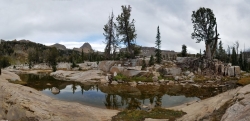
Alaska Basin
Driggs, Idaho
10.0 miles E of Driggs, IdahoThe Alaska Basin Trail is a stunning trail through the Jedediah Wilderness near Driggs, Idaho and goes East into Wyoming, just outside of Grand Teton National Park. The trail is wide and has easy terrain for the feet, but it is long, so it's best suited for intermediate to advanced hikers. There are spots on the trail where river crossing is necessary, so be prepared to rock hop, cross logs, or just get your feet wet.
Because the trail is in a wilderness area, rather than a National Park, no overnight camping permits are required; however, open fires are not allowed, so plan on bringing a camping stove. Carry bear spray and, if you are camping, plan on bear proofing your food and waste.
The trail features a variety of landscapes such as lush vegetation and wildflowers (peak season is July to August), rushing rivers and streams, the majestic Teton Mountain Range, and of course, the serene Alaska Basin. There is plenty of wildlife; black bears and moose both have been spotted on the trail. Enjoy their beauty, but please use precaution and respect their territory.

East Fork Mink Creek Trail
Pocatello, Idaho
11.4 miles S of Pocatello, IdahoIf it's early in the season and you're anxious to dust off the skis, the East Fork Road is a good starting place. The East Fork road to Justise Park Rec Area joins the Bannock Highway about two miles past the boundary to the National Forest. Turn left at the intersection indicating Camp Taylor or Scout Mountain Campground. The gate at bottom of Lead Draw closes on 11-15 each year but with sufficient snow closes about 12-28/30. The lower gate is opened and you can drive a couple of miles farther to the gate just above the areas managed by Pocatello Outdoor Program (East Mink x-country ski area).Courtesy of www2.isu.edu

Wasatch Crest
Salt Lake City, Utah
20.6 miles SE of Salt Lake City, UtahThe Wasatch Crest Trail (GWT) is probably one of the best, if not the very best, singletrack trail in Utah! I prefer to do this ride as an out and back, starting at Millcreek Canyon's Big Water Trailhead! You can start at the top of Scotts Pass, but you won't get the full effect of the ride!! You can also start at the Mill D North Fork trail up to Lake Desolation. Take extreme care when crossing the "Spine" above Lake Desolation, it is best just to get off and walk the short section! You'll see what I mean when you get there!!! Courtesy of Singletracks.com
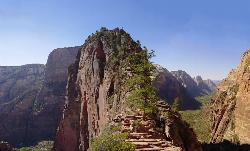
Angels Landing
Springdale, Utah
5.5 miles NE of Springdale, UtahAngels Landing is one of the park's most strenuous day hikes, but it offers spectacular vistas. It follows the West Rim Trail through the famous switchbacks of Walters Wiggles, past dramatic views at Scout Lookout, and on up to a high point 1,500 feet above the canyon floor. The steep, isolated cliff faces along this trail provide critical habitat for several species, including the peregrine falcon. This small raptor climbs, swoops, and dives with stunning power and grace, reaching speeds of over 100 miles per hour.
Walters Wiggles, an amazing series of 21 steep, stone-walled switchbacks, was carved into the cliff in the 1920s during the tenure of Superintendent Walter Ruesch. Scout Lookout, just above Walters Wiggles, offers a resting place, breathtaking views, and a preview of the very steep hike on up to Angels Landing and the canyon's West Rim. (Many people make the Lookout their destination.) Angels Landing provides one of the most dramatic vistas in Zion, across the canyon to Observation Point, Cable Mountain, and other East Rim features. The last 3/4 mile follows a narrow ridge with deadly drop-offs of 1,000 feet on either side. There are chains to hold on to in some sections, but not all. This section is not recommended for young children, those with fear of heights, or individuals with balance issues or other health concerns.
This trail is strenuous and steep, with numerous narrow sections and unprotected drop-offs. Not for anyone who is out of shape or has a fear of heights. Bring plenty of water. Start early in the day for the best conditions and be sure that you are off the trail before dark or during electrical storms.
Roundtrip: 4 hours / 4.8 miles
Elevation Gain: 1488 feet
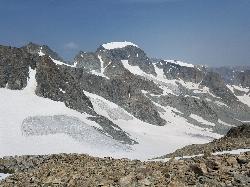
Gannett Peak
Gannett Peak, Wyoming 82513, USA
At 13,308 feet in elevation, Gannett Peak is considered to be one of the most difficult state highpoints, rivaled only by Alaska's Denali, Washington's Mount Rainier, and Montana's Granite Peak which have a range of difficulties based on weather and conditions of the climb.
July to August are considered to be the best times to go. If you try too early in the season, all the streams and lakes are still frozen over. If you go too late, then snow and bad weather is more common which makes more a much more strenuous hike. The downside to going in July and August is that the Wind Rivers are renowned for horrendous swarms of voracious mosquitoes. Many climbing parties prefer visiting during July when the Gooseneck Glacier bergschrund (and other crevasses) are not yet fully opened (if at all). Snowpack can actually make a summit attempt less strenuous than travelling on ice and/or rock for long distances.
There are three major trails to the top:
- Pole Creek Trail to Titcomb Basin
This is a 40 mile round trip with approximately 9050 feet cumulative elevation gain. This route has long been considered the main standard approach for Gannett Peak, although the Glacier Trail approach from the east has been gaining popularity during recent years. This western approach is a well-travelled route full of spectacular scenery and views. - Glacier Trail
This trail is a 50 mile round trip from the Dubois side and has a cumulative elevation gain of 10,750 feet. The biggest advantage to this route is it puts you at a higher camp for your summit day giving you a better chance of success and less strenuous terrain than the standard western approach. - Ink Wells Trail
The advantage of this route is that a large amount of distance and effort can be saved by the time the route intersects with the Glacier Trail. However, the disadvantage of this route is that access is both limited and expensive. This route crosses the Wind River Indian Reservation, which requires special permission, guidance, and transportation to travel through. Reservations are required in advance and sometimes difficult to achieve, and even if a reservation can be made, the cost can be substantial.
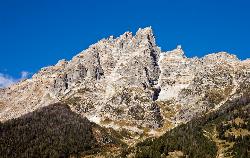
Teewinot Mountain
Jackson Hole, Wyoming
17.7 miles N of Jackson Hole, WyomingTeewinot Mountain is one of the great sights of Grand Teton National Park — a soaring 12,325-foot fin of rock that rises straight above Jenny Lake and dominates the view of the range from the valley floor. Its name comes from a Shoshone word meaning “many pinnacles,” and while it can look like a hiking peak from a distance, reaching its summit is a committing mountaineering objective, not a trail walk.
The standard line is the East Face, begun from the Lupine Meadows trailhead south of Jenny Lake. From there the route climbs relentlessly — roughly 4,000 feet of gain in under two miles — first up dozens of steep switchbacks, then through open, flower-filled meadows, and finally onto the face itself. High on the mountain, around 10,500 feet, you pass beneath two prominent rock spires known as the Idol and the Worshipper, a landmark that marks the way onto the upper face.
The climbing is rated roughly 4th class and is often done without a rope by experienced parties, but that grade undersells it: the Tetons are famously sandbagged, the route-finding is complex, exposure is serious, and much of the rock — especially up high — is loose. Snow lingers in the couloirs and the steep “Narrows” well into summer, where an ice axe (and the skill to use it) can be essential. Teewinot is widely considered the deadliest peak in the Tetons: the upper face funnels rockfall, and the crux for many parties is the descent — downclimbing the same steep, loose ground, where many falls and fatalities have occurred. A rope for rappels and downclimbing is wise.
This is a full, dawn-to-dusk day for fit, experienced mountaineers with solid scrambling skills, good judgment, and the gear to match — a helmet is a must for the rockfall, and many climbers hire a guide through the park's concessioners (such as Exum Mountain Guides or Jackson Hole Mountain Guides) for a first ascent. The usual season is mid-summer into early fall, once the snow has consolidated or melted out.
A park entrance fee applies, and this is grizzly country, so carry bear spray on the approach and store food properly. Start in the dark to be off the summit before afternoon thunderstorms build, know the descent as well as the ascent, and turn around if the rock, weather, or your party isn't solid. And if you're not equipped for serious alpine terrain, take heart: Teewinot is arguably even more beautiful from below — admire its pinnacles from the Jenny Lake shore, one of the finest mountain views in the country.


