


9 locations
Add Location
 Full Listing
Show more
Cave
Added on 15 Nov 2021
Full Listing
Show more
Cave
Added on 15 Nov 2021
 Full Listing
Show more
Cave
Added on 15 Nov 2021
Full Listing
Show more
Cave
Added on 15 Nov 2021
 Full Listing
Show more
Cave
Added on 15 Nov 2021
Full Listing
Show more
Cave
Added on 15 Nov 2021
 Full Listing
Show more
Cave
Added on 15 Nov 2021
Full Listing
Show more
Cave
Added on 15 Nov 2021
 Full Listing
Show more
Cave
Added on 15 Nov 2021
Full Listing
Show more
Cave
Added on 15 Nov 2021
 Full Listing
Show more
Cave
Added on 14 Jun 2021
Full Listing
Show more
Cave
Added on 14 Jun 2021
 Full Listing
Show more
Cave
Added on 25 Feb 2021
Full Listing
Show more
Cave
Added on 25 Feb 2021
 Full Listing
Show more
Cave
Added on 25 Feb 2021
Full Listing
Show more
Cave
Added on 25 Feb 2021
Owl Cave
Fuller, Idaho
6.2 miles N of Fuller, IdahoCLOSED.
Full Listing
Show more
Cave
Added on 18 Nov 2021
Owl Cave is one of the most important archaeological sites in the American West, a collapsed lava tube on the volcanic Snake River Plain about 20 miles west of Idaho Falls, Idaho. Part of the Wasden Site, a cluster of three collapsed lava-tube caves (Owl Cave, Dry Cat Cave and Coyote Cave), it has yielded an extraordinary record of Ice Age animals and some of the oldest human artifacts in the region. It is a place of genuine scientific significance, and understanding what it is also means understanding why it is not an open recreational cave.
The discoveries here are remarkable. Excavated on and off between 1965 and 1977 by the Upper Snake River Prehistoric Society and Idaho State University, Owl Cave produced a dense bison bone bed with more than 6,000 faunal elements, radiocarbon-bracketed roughly between 7,800 and 8,200 years before present, along with deeper layers holding the remains of dire wolf, camel and Columbian mammoth. The oldest, deepest deposits date back around 14,000 years. Excavators recovered human objects too, including Folsom projectile points and even a carved doll's head, making the cave a touchstone for understanding the earliest peoples of the Snake River Plain.
The essential thing to know is that Owl Cave sits on private land and is a protected, nationally recognized archaeological site, not a cave open for casual exploration. It is not a drop-in destination, and disturbing or trespassing on an archaeological site is both illegal and destructive of an irreplaceable record. We list it for its history and significance, not as a place to go poke around.
The good news for anyone drawn to the story is that the discoveries are accessible in the best possible way. The remarkable Wasden collection of Ice Age fossils and artifacts has found a home at the Museum of Idaho in Idaho Falls, where the finds can be seen and understood in context, which is a far richer experience than the cave itself would offer even if it were open.
The surrounding Snake River Plain is stark, fascinating volcanic country, and the broader region offers plenty of legitimately open lava tubes and public lands for those wanting to explore caves and the Great Rift landscape responsibly.
Treat Owl Cave as what it is: a window into 14,000 years of life on the Snake River Plain, best honored by visiting the collection at the Museum of Idaho, supporting the researchers who protect it, and leaving the site itself undisturbed. Its value lies in what it can still teach, and that depends on it being left intact.
Dynamite Cave
Shoshone, Idaho
3.7 miles S of Shoshone, Idahoa very unquie cave South of shoshone ID. cave has a old dynamite container as you enter into the cave also a free standing bridge outside the entrance of the cave
Tomb Cave
West Magic, Idaho
2.6 miles S of West Magic, Idahofun cave south of mammoth cave. cave has N and S cave the South is a much more fun the N cave
Maze Cave
West Magic, Idaho
1.5 miles S of West Magic, IdahoThis is one of the more fun caves in the area located next to the t cave this cave has a upper lower tunnels both meet in the back the lower has a cave in but you can drop back in it a little further down
T Cave
West Magic, Idaho
1.5 miles S of West Magic, IdahoThis cave sits just north of the gwinn cave and mammoth cave and SW of the Maze cave you enter the cave and go back about 300 yards or more and you come to a great big T where you can go left and right about .25 mi each way
Gwinn & Gwinn Cave
West Magic, Idaho
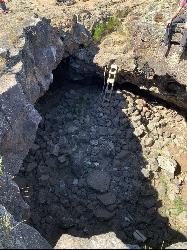
2.0 miles S of West Magic, IdahoGwinn and gwinn cave is located near the famous Idaho Mammoth cave this cave you decend down a ladder and cave goes back in at least a quarter mile. great spot to camp
Gwinn Cave
Shoshone, ID, USA
massive lava tube where you descend a ladder cave is a little more then a .25 miles long
Clay Caves North
Eden, Idaho
4.5 miles W of Eden, IdahoClay Caves is a genuinely wild lava-tube caving destination on the volcanic Snake River Plain of southern Idaho, out in the sagebrush country reached within a half-hour drive from the Twin Falls area. This is not a developed show cave with lights and railings; it's a raw, dark, undeveloped lava tube said to run more than a mile into the earth, the kind of place that rewards the well-prepared and genuinely punishes the careless. For experienced, equipped explorers, it's one of the more adventurous caves in the region.
The cave itself is a classic basalt lava tube. The entrance opens up and the passage leads for over a mile underground, fairly open and roomy at the beginning before narrowing as it extends deeper into the ground. That combination, a big walkable start that tightens the further you go, is part of what makes it appealing and part of what makes it dangerous: it's easy to keep going, and easy to lose track of the way out.
Come properly equipped or don't go past the entrance. Beyond roughly the first 100 yards, headlamps and backup flashlights are absolutely required, and people have genuinely gotten lost deep within the cave. Multiple, independent light sources, a helmet, sturdy boots, warm layers (lava tubes stay cold year-round), and ideally a partner and someone who knows your plan are the baseline for a cave like this. Do not rely on a phone flashlight.
Access is part of the adventure and part of the filter. The approach involves gravel roads best suited to a high-clearance vehicle, and walking the last stretch is often the smarter choice given the rough, uneven surface; plan on a hike of over a mile to reach the cave, watching for the marked "cave" rock. This is remote, exposed high-desert country with no services and limited cell coverage.
The best conditions are the shoulder seasons and cooler months for the surface approach, since the surrounding plain bakes in summer, while the cave interior holds a cold, steady temperature all year. There's no water and no shade out here.
Bring at least two reliable light sources per person plus spare batteries, a helmet, gloves, warm layers, sturdy footwear, plenty of water, and a partner. Tell someone where you're going and when you'll be back. Tread lightly and take nothing, as lava tubes are fragile environments. For prepared, experienced cavers looking for a real underground adventure on the Snake River Plain, Clay Caves delivers a genuinely wild mile into the dark.
Lariat caves
American Falls, Idaho
19.4 miles NW of American Falls, IdahoLariat Cave is a massive lava tube out on the high desert near American Falls, Idaho — one of the biggest caves in this volcanic corner of the state, in the same lava country that runs toward Craters of the Moon. For cavers and adventurous families, it's a genuinely impressive underground space: a huge, dark tunnel carved by ancient molten lava, cool and quiet no matter the weather above.
The cave is a classic lava tube, formed when the surface of a lava flow hardened while the molten rock beneath drained away, leaving a hollow passage behind. Lariat is notably large, and part of the fun is a loop near the back of the cave: the passage splits about two-thirds of the way in, letting you make a circuit rather than simply backtracking. It stays at a constant, cool temperature year-round, which has long made it popular — Boy Scout troops have used it as a sheltered campsite, much like the well-known Dead Horse Cave over near Gooding.
Getting there is the real challenge. The cave is reached via a rough dirt road off Crystal Ice Cave Road — the final stretch runs about 1.5 miles of deeply rutted dirt that is not suitable for low-clearance vehicles. In heavy rain or spring snowmelt it can turn to impassable mud, and it may be blocked by snow for much of the winter, with the cave entrance itself sometimes buried until the end of April. Plan your visit for dry summer or early-fall conditions, and bring a high-clearance or four-wheel-drive vehicle.
The cave sits in a fascinating volcanic landscape. This part of the Snake River Plain near American Falls is dotted with lava tubes and features, including the well-known Crystal Ice Cave along the same access road — a nearby cave famous for its ice formations. Exploring Lariat pairs naturally with a broader day poking around the volcanic country of southeastern Idaho, so bring good maps and plan your route, since these backroads are remote and lightly traveled.
Come prepared with proper caving gear. Bring at least two light sources per person (the cave is completely dark), wear a helmet and sturdy, closed-toe shoes for the rocky floor, and pack a warm layer, since it stays chilly inside even on the hottest day. This is remote country with little cell service, so don't go alone and tell someone your plans.
Tread lightly out here: pack out everything you bring, don't disturb any wildlife (including bats) using the cave, and leave the passages as you found them. For those willing to brave the road, Lariat Cave rewards you with one of the largest and most enjoyable lava-tube explorations in the American Falls area.
×


