


28.4K Craters of the Moon National Monument by endovereric
first prev 1 next lastDescribed as a "weird and scenic landscape", Craters of the Moon certainly lives up to its reputation. It was established in 1924 to preserve the unique volcanic features of this enormous lava field. The 750,000-acre monument contains a diverse array of volcanic features including volcanic rifts, cinder cones, spatter cones, shield volcanoes and lava tube caves. A surprising number of plants and animals have adapted to live in the harsh volcanic and high desert environment. It is an excellent site for hiking, bird watching, photography, backpacking and caving (permits required). The monument is cooperatively managed by the National Park Service and Bureau of Land Management. Summer activities include guided cave walks and evening programs at the campground. Winter activities include Winter Ecology Workshops, snowshoeing, and cross-country skiing. Park is open 24 hours/day year-round. Visitor Center: Memorial Day-Labor Day 8am-6pm, rest of the year 8am-4:30pm. Closed winter holidays.
North Crater Flow
Arco, Idaho
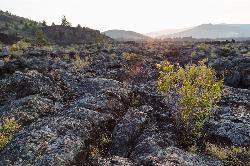
17.9 miles SW of Arco, IdahoThe North Crater Flow Trail is one of the best first stops at Craters of the Moon National Monument, a short, paved, accessible loop that carries visitors out across a genuine river of hardened lava on the volcanic Snake River Plain of central Idaho. Only about a third of a mile long, it winds over a pahoehoe lava flow that spilled from the North Crater vent roughly 2,100 years ago, making it one of the youngest flows in the whole Craters of the Moon lava field and a vivid, close-up introduction to how this alien landscape was built.
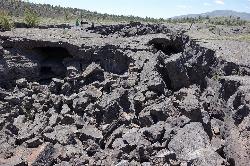
The trail is designed to teach. A paved boardwalk, elevated just above the lava, carries you over the flow while interpretive signs along the path explain the volcanic features underfoot, and because the short loop passes such a wide range of volcanic formations, it's an ideal opening stop before exploring the rest of the monument. You walk directly among both smooth, ropey pahoehoe lava and rough, jagged aa lava, the two classic textures of a basalt flow, seeing the difference between them at arm's length.
One of the trail's signature features is a set of large lava fragments, chunks of the North Crater wall rafted here on the moving flow and left stranded when it cooled, a dramatic illustration of the forces that shaped the plain. It's a genuinely educational half-hour that turns abstract geology into something you can stand beside.
The landscape is stark, black and beautiful, and it deserves respect: the lava is sharp, the ground radiates heat, and there is essentially no shade, so summer midday is hot and the cooler hours of morning and evening are far more comfortable. The best season for the hike runs roughly April through November.
North Crater Flow sits right along the monument's loop drive near the visitor center, easily combined with Devil's Orchard, the spatter cones, and the caves for a full day among the volcanics. For a short, accessible, genuinely eye-opening walk across a 2,000-year-old lava flow, complete with textbook pahoehoe and aa lava and rafted crater fragments, the North Crater Flow Trail is one of the finest introductions to Craters of the Moon.
Devil's Orchard Trail
Visitors Center, Craters of the Moon National Monument
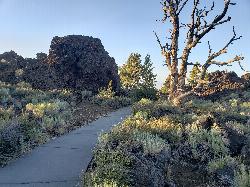
17.1 miles N of Visitors Center, Craters of the Moon National MonumentThe Devil's Orchard Trail is a short, fascinating, and beautiful introduction to the strange volcanic world of Craters of the Moon National Monument in central Idaho. A paved, wheelchair-accessible half-mile loop, it winds through a field of cinder beds studded with jagged fragments of the North Crater cinder cone, standing like a garden of dark, twisted rock islands rising from the black volcanic ground, a scene that early visitors thought looked like an orchard planted by the devil.
The geology behind it is remarkable. About 2,000 years ago, large chunks of the North Crater's wall were broken off during an eruption and rafted here on flowing lava, coming to rest as the "trees" of this stone orchard. In the centuries since, cinder eruptions and slow plant growth have softened the scene into a genuine volcanic garden, and the contrast of hardy vegetation against raw black cinder is the whole appeal.
Spring is the trail's showpiece season. In springtime the wildflower displays here are glorious, with carpets of tiny dwarf monkeyflowers spreading pink across the dark cinders, a stunning and fleeting sight against the volcanic backdrop. The best window for the hike overall runs roughly April through November, with spring for flowers and fall for cool, comfortable walking.
Because it's paved, level, and short, Devil's Orchard is accessible to nearly everyone, and interpretive exhibits line the loop, describing the rock and wildlife formations and challenging visitors to consider the difficulty of protecting such a fragile environment. It's an excellent, low-effort stop that packs in geology, ecology and a genuine sense of the monument's otherworldly character.
The lava landscape is exposed and shadeless, and the black cinder radiates heat, so summer midday visits are hot and the cooler morning or evening hours are far more pleasant. Craters of the Moon sits along the Snake River Plain between Arco and Carey, an easy stop off the highway, and Devil's Orchard pairs naturally with the monument's caves, cones and lava flows for a full day among the volcanics. For a short, accessible, genuinely captivating walk through a garden of volcanic rock, it's one of the highlights of the park.

Caves Trail
Visitors Center, Craters of the Moon National Monument
16.7 miles N of Visitors Center, Craters of the Moon National MonumentThe Caves Trail at Craters of the Moon National Monument leads into one of the most otherworldly landscapes in Idaho: a field of lava tubes formed by ancient volcanic eruptions on the high sagebrush desert of the Snake River Plain. Along this short trail, four remarkable caverns lie open to explorers, offering a rare chance to descend beneath the black lava into cool, dark tubes left behind by rivers of molten rock thousands of years ago. It's the highlight of a monument that genuinely looks like another planet.
Four caves are accessible from the trail, each with its own character. Indian Tunnel is the star, the largest and longest, measuring about 30 feet tall and 800 feet long, with several massive collapsed skylights that let in so much daylight you don't even need a flashlight to walk through it. Boy Scout Cave is the opposite experience: it holds onto its winter chill all year and keeps ice on its floor even in summer. Dewdrop Cave and Beauty Cave round out the quartet, darker and requiring real light.
A free permit is required to enter any of the caves, and it matters: the permit program exists to protect the monument's bats from white-nose syndrome, a devastating disease spread on gear and clothing. You pick up the free permit at the entrance station, the visitor center, or on a ranger-guided walk, and rangers may ask whether your gear has been in other caves. Bring at least one good light per person for the darker caves, and a warm layer, since the tubes stay cold year-round.
The landscape between the caves is part of the experience: a jagged, black expanse of lava with almost no shade, which bakes in summer, so early or late in the day is far more comfortable, and sturdy shoes are essential on the sharp, uneven basalt. The trail itself is relatively short, but exploring all four caves makes for a genuine half-day adventure.
Craters of the Moon sits in central Idaho along the Snake River Plain, an easy detour off the highway between Arco and Carey. Between walking through the skylit cathedral of Indian Tunnel and standing on ice in Boy Scout Cave in July, the Caves Trail is the unmissable heart of one of the strangest and most fascinating parks in the country.
Inferno Cone
Visitors Center, Craters of the Moon National Monument
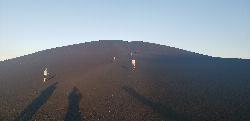
16.6 miles N of Visitors Center, Craters of the Moon National MonumentCinder cones form when gas-rich volcanic froth erupts high into the air and then piles into a mound. Climb Inferno Cone, if you wish, but don't be disappointed if you are unable to locate the source of the eruption at the top. These cinders were actually blown by the wind, and possibly squirted in this direction, from a vent far below near the Spatter Cones parking lot.
The trail to the top of Inferno Cone is steep, but rewards you with panoramic views of the Great Rift, Snake River Plain, and Pioneer Mountains. On clear days you may see the Teton Range, 100 miles to the east. Do not climb in high winds! You will be very exposed and the cinders are sometimes picked up by the wind.Courtesy of nps.gov
North Crater Trail
Visitors Center, Craters of the Moon National Monument
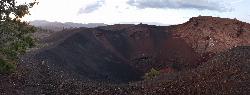
16.6 miles N of Visitors Center, Craters of the Moon National MonumentThis one-way trail is especially interesting for its variety. The trail traverses North Crater and drops into the crater mouth, the vent for the North Crater flow. Notice that the northwest flank of North Crater is missing. An eruption tore the wall apart, and a series of flows rafted the fragments away. The trail continues to the rim of Big Craters before descending to the Spatter Cones. No off-trail travel is permitted in the Big Craters area in order to protect fragile lava formations.Courtesy of NPS.gov
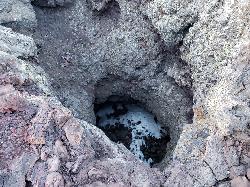
Snow Cone
Visitors Center, Craters of the Moon National Monument
16.6 miles N of Visitors Center, Craters of the Moon National MonumentThe Snow Cone is one of the more surprising little features at Craters of the Moon National Monument, a small, narrow, deep spatter cone on the volcanic Snake River Plain of central Idaho that holds onto snow at its shadowed bottom year-round, even through the heat of an Idaho summer. It's a quick, easy, genuinely fascinating stop that lets you peer straight down into the plumbing of an ancient volcano and see winter surviving in the depths of a black lava landscape in July.
Spatter cones like this one tell a vivid geological story. They formed during the dwindling stages of an eruption, when hot blobs of molten lava were thrown a short distance into the air and fell back around a small central vent, cooling and sticking together to build the walls of what amounts to a miniature volcano. The Snow Cone is a particularly deep and narrow example, and that shape is exactly why snow, sheltered from sun and warm air at the bottom, lingers all year.
Visiting is easy and rewarding. A short walk up the Snow Cone Trail, roughly half a mile round trip and rated an easy stroll of about half an hour, brings you to the rim where you can look down into the cone. The trail is wheelchair accessible, and it pairs naturally with the adjacent Spatter Cones Trail, letting you take in several of these mini-volcanoes in a single short outing.
The lava landscape is exposed and shadeless, and the black basalt bakes in summer, so this is a spot best enjoyed with sun protection and, in warm months, in the cooler morning or evening hours, and the rims of the cones are real drop-offs, so keeping back from the edge and watching children matters.
The Snow Cone sits within the strange, beautiful volcanic expanse of Craters of the Moon, easily combined with the monument's caves, cinder cones and lava flows for a full day among the lava. For a short, accessible, only-here experience of standing over a snow-filled mini-volcano in the middle of an Idaho summer, the Snow Cone is a memorable little wonder.
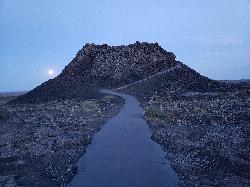
Spatter Cones
Visitors Center, Craters of the Moon National Monument
16.6 miles N of Visitors Center, Craters of the Moon National MonumentThese miniature volcanoes formed when blobs of molten lava were lobbed into the air during the last gasp of an eruption sequence that ended about 2,100 years ago. Craters of the Moon is well known for these beautiful volcanic features. Please help protect them by staying on trails.
Like Yellowstone's Old Faithful, the spatter cone chain at Craters of the Moon best symbolizes the essence of this special place. Created during a dwindling stage of an eruption, the spatter cones formed as hot lumps of lava were thrown a short distance into the air only to fall back to earth around a small central vent. As the still molten blobs landed on top of each other, they cooled and adhered to nearby pieces to form the walls of what could be considered a mini-volcano. The Snow Cone portion of the Spatter Cones Trail is fully accessible.Courtesy of nps.gov
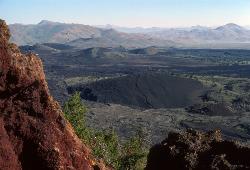
Broken Top Loop Trail
Visitors Center, Craters of the Moon National Monument
15.5 miles N of Visitors Center, Craters of the Moon National MonumentThe Broken Top Loop Trail provides an opportunity to hike over, under and around the youngest volcano on the Snake River Plain. The event that created this cinder cone and associated lava flows culminated about 2,000 year ago at the end of the most recent eruptive cycle. Find out more about the outstanding lava features along the trail by following the trail guide and numbered signs.
Please protect fragile lava features by staying on the designated trail and by following rock cairns across the lava. If you wish to explore Buffalo Cave, don't forget to bring a flashlight and watch your head as you enter the low ceiling of this lava tube.
The Broken Top Loop Trail is one of the most outstanding trails within Craters of the Moon. You can observe nearly every type of volcanic feature characteristic of the basaltic eruptions that created this unearthly landscape. Pick up a trail guide at the visitor center or at the trailhead sign and follow the numbered signs along the trail to learn more. This trail also provides access to Buffalo Caves (best entrance is near sign #8). Obtain a free permit at the visitor center, wear sturdy shoes and bring a flashlight before entering this or any other cave in the park.Courtesy of nps.gov
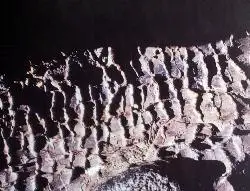
Tree Molds Trail
Visitors Center, Craters of the Moon National Monument
15.5 miles N of Visitors Center, Craters of the Moon National MonumentWhen molten lava advanced through this area it flowed through a grove of living trees. As the trees burned, moisture was released as steam, cooling the hot lava just enough to leave an impression of the charred wood on the surface.
Tree molds may appear as vertical holes in the lava, or if the tree fell on to the surface of a molten flow, a horizontal mold. Look for wooden posts that indicate the location of both types of tree molds near the end of this trail.
Follow the paved ramp that goes south of the trailhead sign near the parking lot. This trail winds through shrubs and stands of limber pine within the Craters of the Moon Wilderness before reaching the edge of the Blue Dragon Flow. While still molten, this lava flow knocked down and ignited trees. The charred tree trunks left impressions in the lava rock. In other places, the trees remained standing as the lava encased them, leaving vertical molds in the cooling lava.Courtesy of nps.gov
Wilderness Trail
Visitors Center, Craters of the Moon National Monument
15.5 miles N of Visitors Center, Craters of the Moon National MonumentYou will have a sense of solitude as you travel into the Craters of the Moon Wilderness. Begin the trail on the sidewalk that parallels the roadway and turn right to follow the direct route across a young lava flow near the entrance to Buffalo Caves. Follow the metal posts across the lava. After stepping off of the lava turn right at the trail sign. You then pass between Big Cinder and Half Cone cinder cones. Check out the "lava trees" at the short signed trail that leads to these features. Observe Crescent Butte and Coyote Butte as you travel through "trench mortar flats". Echo Crater is a great place to camp! Obtain a required backcountry permit at the visitor center and be prepared to walk through the sage brush to access the easiest entrance on the north-eastern side of the crater.Courtesy of nps.gov


